The long-awaited trial of Hissène Habré, was adjourned almost as soon as it was opened, as an outburst from the former dictator of Chad caused a scene in the courtroom.
The long-awaited trial of Hissène Habré, was adjourned almost as soon as it was opened, as an outburst from the former dictator of Chad caused a scene in the courtroom.
The government of the Democratic Republic of Congo and United Nations peacekeepers should urgently take steps to arrest and transfer Sylvestre Mudacumura, military commander of the Democratic Forces for the Liberation of Rwanda (FDLR), to the International Criminal Court.
Victims Bring Dictator Hissène Habré to Trial: The inauguration of a special court in Senegal marks a turning point in the long campaign to bring to justice the former dictator of Chad. Habré is accused of thousands of political killings and systematic torture during his presidency, from 1982 to 1990.
Fermina Lopez Cash, a 47-year-old woman from Guatemala, sits in her home with a photo of her 13-year-old son, Omar, who died in July 2010 in the Arizona desert trying to cross the US-Mexico border to join her and his older siblings in Phoenix. Only 9 years old when she left, Lopez Cash said Omar begged to come to the US as well. A middle-aged woman offered to come with him, and they hired a "coyote" (smuggler) to take them across the border.
Almost three years later, the remains of a teenage boy that had been found in the Arizona desert along with those of an older woman, were confirmed as those of Fermina's son.
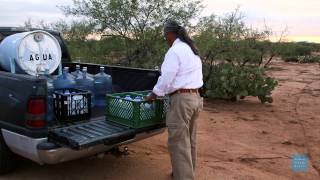
Mike Wilson, a volunteer with the Tucson, Arizona-based Humane Borders, places containers of water in the desert in the hope of preventing more migrant deaths and leads search missions for families looking for loved ones. Wilson is a member of the Tohono O'odham Nation, on whose reservation many of the migrants have died. Members of his tribe and the congregation he used to serve as a pastor, he said, have criticized him for trying to save lives of people who are breaking federal immigration laws. "As your pastor, I have to choose between two sets of law," he tells them. "Which law is above the other? Federal immigration laws or God's moral, universal law that you take care of the stranger?"
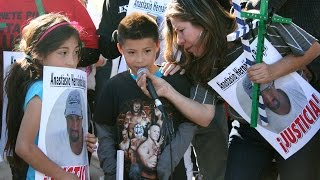
In 2010, border guards beat and shocked Anastasio Hernandez Rojas with a stun gun at the San Ysidro port of entry near San Diego, California. He died three days later. An autopsy report ruled his death a homicide, with hypertension and methamphetamines as contributing factors. Rojas had been deported a few months earlier and was apprehended when he tried to rejoin his family, including his wife, Maria Puga, and their 7-year-old twins, Daniela and Daniel, pictured here near the wall where their father was beaten. Puga, who has successfully demanded a governmental investigation into her husband's death, says, "I want my kids to grow up peacefully, not with bitterness. That is why I continue to search for justice."
Angie and Peter Kim came to the United States from South Korea with their parents when they were 9 and 7 years old respectively. According to them, their grandmother, a US citizen, had petitioned for their family, they said, but after years of waiting due to a backlog of visas, she died just before they could complete the process. When their father became a permanent resident through marriage to a US citizen, he and Peter became permanent residents. Peter is now a US citizen, but Angie was over 21 years old at the time and could not gain legal status. Without congressional action on immigration, she may never become a US citizen like her brother. Angie knows that in some ways she is lucky. "I'm able to sit next to my brother right now but I know...children, or parents who are literally separated from each other."